
The economy, which grew at 6.5 per cent in the year ended March 2012, is expected to grow 5.7 per cent to 5.9 per cent this fiscal year, the slowest since 2002/03.
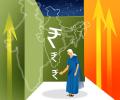
Citing various macroeconomic parameters that are doing pretty well, India's G20 Sherpa and former CEO of Niti Aayog Amitabh Kant projected that the country is all set to overtake Japan as 4th largest economy in the world by 2025. The size of India's GDP is currently ranked 5th, after the US, China, Germany, and Japan. It overtook the UK in 2022.

India's manufacturing sector saw a slower growth rate for the second straight month in May but stayed firmly in expansion mode with global sales increasing to the greatest extent in over 13 years, a monthly survey said on Monday. The seasonally adjusted HSBC India Manufacturing Purchasing Managers' Index (PMI) fell from 58.8 in April to 57.5 in May, signalling a slower but substantial improvement in the health of the sector. The index had climbed to a 16-year high of 59.1 in March.

Current Account Deficit is projected at 1.2 per cent and 1 per cent of GDP in 2014-15 and 2015-16.

Domestic and external environment still remain "challenging".

International Monetary Fund has cut its 2003 global growth forecast to 3.2 per cent from 3.7 per cent due to the Iraq war and stock market declines, and is particularly worried about weak German growth.

Pratham Barot, CEO and co-founder, Zell Education, explains how specialised courses in finance can help you earn a cushy six-figure salary.
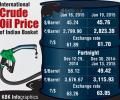
OPEC hopes lower fuel prices will stimulate more demand in the long run

Describing the current level of inflation as "unacceptable", Chief Economic Adviser in the Finance Ministry Kaushik Basu on Thursday indicated the government will revise downward the growth forecast for 2011-12.

Ajit Balakrishnan recalls some lessons from the last time people talked of 'convergence' -- the mid-1990s.
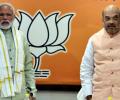
Corporate leaders said a stable government at the Centre will help boost infrastructure spend, address agricultural distress, and encouraging employment.

The IMD has fancy weather-monitoring radars in the name of providing better forecasts.
We should be less doctrinaire about monetary and exchange rate policies and stimulation packages.
Not yet, says Nouriel Roubini. Economic recovery everywhere will be weaker and will take longer than expected.
The World Bank on Wednesday cut India's economic growth projection to 6% for the current fiscal from 6.9% estimated earlier and blamed the slow down on corruption scandals and a host of policy issues including uncertainty in tax policies.

'India has benefited from lower oil prices and remains the fastest-growing large economy in the world.'
The statement, issued after the 2-day meeting of the 6-member Monetary Policy Committee of the Reserve Bank of India, also said that recapitalisation of public sector banks along with resolution of stressed assets under the Insolvency and Bankruptcy Code (IBC) will create demand for fresh investments.
Ever since the credit crunch surfaced in late 2007, there has been a dramatic fall in the prices of financial assets amounting to a total wealth erosion of $28 trillion across the world, economic forecasting consultancy Oxford Economics has said.
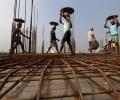
The review will not only present data, trends but also list out the achievements of the Narendra Modi government

The Indian economy is projected to grow at 6.3 per cent in current financial year aided by investment and domestic demand. According to a World Bank report released on Tuesday, India continues to show resilience against the backdrop of a challenging global environment. In India, which accounts for the bulk of South Asia region, growth is expected to remain robust at 6.3 per cent in 2023-24, India Development Update of the World Bank said.

The Centre for Monitoring Indian Economy (CMIE) has revised its GDP growth forecast for the current fiscal to 6.2 per cent from six per cent announced last month.

The Sensex will then rally further and end 2016 at 28,000, according to the median forecast of 50 analysts polled in the past week.

US's terrible political and economic leadership will ultimately cost the dollar its value. India must act early to avoid being dragged down, suggests R Jagannathan.
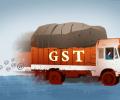
Goods and Services Tax collections jumped 10.4 per cent to over Rs 1.72 lakh crore in January, reflecting buoyant economic activity and setting the stage for the next phase of GST reforms. This is the second-highest monthly collection ever and marks the third month in this financial year with a collection of Rs 1.70 lakh crore or more, a finance ministry statement said on Wednesday.
The United Nations has warned that the world is on the brink of another recession, projecting that global economic growth will slow down further in 2012 and even emerging powerhouses like India and China, which led the recovery last time, will get bogged down.
The National Council of Applied Economic Research (NCAER) on Thursday lowered the GDP projection for the current fiscal to 4.7-4.9 per cent due to exchange rate depreciation.

Most analysts expect the note ban to sharply hit GVA growth in Q3 and Q4, and the central bank's stance is being called into question.

The global construction market is expected to soar to a size of $12.7 trillion by 2020 with the sector output likely to rise sharply over the next decade driven by emerging markets like India, China and Brazil, a report says.

Indian economy is gathering momentum in the second quarter, though inflation would continue to average above the central bank's comfort zone of 6 per cent, said an article in the RBI's monthly bulletin released on Thursday. The consumer price index (CPI) based retail inflation shot up significantly to 7.44 per cent in July, from 4.87 per cent in the preceding month, mainly due to soaring prices of tomato, vegetables and other food items. In his address to the nation on the Independence Day, Prime Minister Narendra Modi vowed to take more steps to contain price rise.
Investors need to ask some basic questions before betting in the markets on the Gujarat model's national success.
Economic think-tank National Council of Applied Economic Research expects India's Gross Domestic Product growth to decelerate to 8.3 per cent during current fiscal

Indian companies are planning to increase investments in the new year to expand capacity, acquire companies, and go on a hiring spree, a survey of top executives showed. They, however, cited rising costs, weak consumer demand, and increasing interest rates as major concerns for 2023 which may impact their plans.
The Prime Minister's Economic Advisory Council on Friday cut its growth forecast for the current fiscal to 7.1 per cent, lower than the previous projection of 7.7 per cent, due to "painful adjustments" to the ongoing global economic turmoil. India's economy had grown 9 per cent in 2007-08.
IMF has praised India's economic performance and has negated the concept of decoupling as economies today are much closely related to each other.
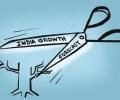
The International Monetary Fund (IMF) on Tuesday lowered India's economic growth projection for the current fiscal to 5.9 per cent from 6.1 per cent earlier. Yet India will continue to be the fastest-growing economy in the world. In its annual World Economic Outlook, IMF also lowered the forecast for 2024-25 fiscal (April 2024 to March 2025) to 6.3 per cent from the 6.8 per cent it had predicted in January this year. The growth rate of 5.9 per cent in the 2023-24 fiscal compares to an estimated 6.8 per cent in the previous year.
.jpg)
Prime Minister's key economic advisor C Rangarajan on Friday lowered the growth forecast for the current fiscal to 5.3 per cent from 6.4 per cent projected earlier and listed out host of measures, including further liberalisation of FDI norms to improve economic condition.
Three American scientists won the 2013 economics Nobel prize on Monday for research that has improved the forecasting of asset prices in the long term and helped the emergence of index funds in stock markets, the award-giving body said.

India, the world's fifth largest economy in the world, is likely to overtake Japan to become the world's third-largest economy with a GDP of $7.3 trillion by 2030, S&P Global Market Intelligence said in its latest issue of PMI. After two years of rapid economic growth in 2021 and 2022, the Indian economy has continued to show sustained strong growth during the 2023 calendar year. India's gross domestic product (GDP) is expected to grow 6.2-6.3 per cent in the fiscal year ending in March 2024, being the fastest-growing major economy this fiscal year.

IT service company Wipro on Friday reported 7.8 per cent year-on-year decline in its consolidated net profit for the March quarter to about Rs 2834.6 crore, and cautioned that the macroeconomic environment remains "uncertain". The Bengaluru-headquartered company, which recently saw a change of guard with Srinivas Pallia taking over at the helm as the new chief executive officer, has given an IT Services revenue growth guidance in the (-)1.5 per cent to +0.5 per cent band for June quarter on a constant currency basis.
